
From Esther Duflo to the Counterfactual of Institutional Learning
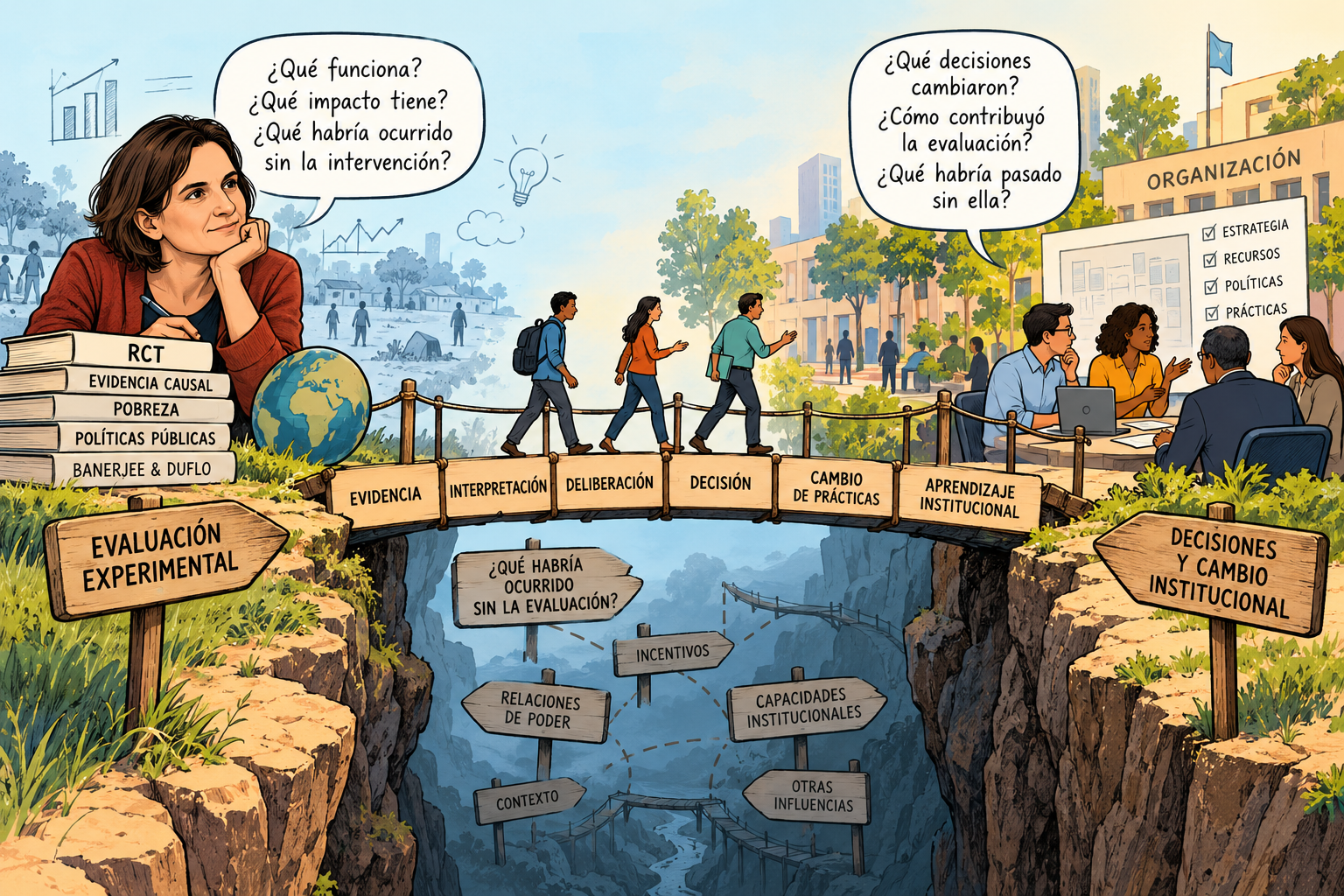
What if we applied the same standards of causal reasoning to our own evaluations that we expect from the programmes we evaluate? This article proposes extending counterfactual thinking beyond the effects of development interventions to examine how evaluations influence decisions, learning and institutional change. After all, demonstrating what works is one thing. Getting organisations to act on that knowledge is quite another.
Duflo’s Revolution and an Uncomfortable Question
In 2019, Esther Duflo was awarded the Nobel Prize in Economic Sciences, alongside Abhijit Banerjee and Michael Kremer, for their experimental approach to alleviating global poverty. Their work helped establish a fundamental question in impact evaluation: how can we know whether an intervention actually produces the results we attribute to it?
The answer involves establishing a credible counterfactual: what would have happened if the intervention had never taken place?
Randomised controlled trials (RCTs) have made a decisive contribution to answering this question, allowing researchers to identify causal effects with a level of rigour that simple comparisons between beneficiaries and non-beneficiaries rarely achieve (Banerjee & Duflo, 2009).
In Poor Economics, Banerjee and Duflo (2011) also demonstrate how experimentation can challenge widely held assumptions about poverty and inform more effective development interventions.
But identifying a causal effect does not answer every evaluation question.
Sigue leyendo
